For years, the goal was simple. Rank #1, get the click, get the customer. That assumption still shapes how most business owners think about SEO, and it's quietly become outdated. Someone can search for exactly what you offer, see an AI generated answer at the top of the page, get everything they needed, and never click through to anyone's website at all. Ranking #1 in that scenario doesn't guarantee you were even part of the answer.
A citation and a ranking are not the same thing
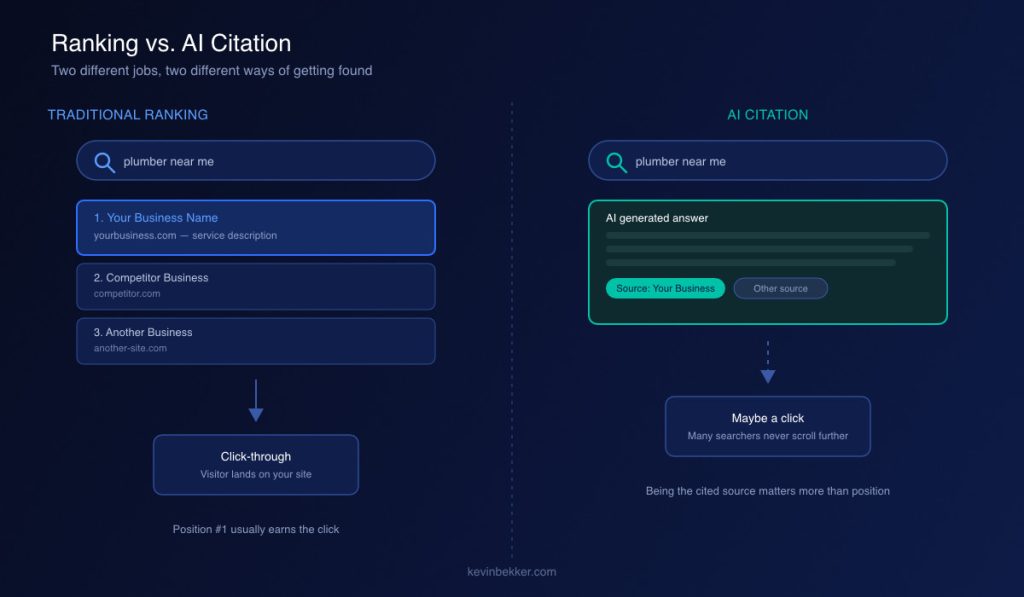
A ranking is a position in a list. A citation is something else entirely, it's when an AI generated answer actually names your business, links to you, or pulls from your content to build its response. You can hold the top ranking position and still receive zero citations, because the AI isn't choosing based on position, it's choosing based on which sources it trusts enough to build an answer from.
This is the distinction most business owners miss. Optimizing for a ranking and optimizing for a citation are related, but they are not the same job.
You can rank well and still get zero AI citations
This is the part that surprises people. A site can rank on page one for years, built on solid backlinks and decent traffic, and still never get mentioned inside an AI Overview. Usually it comes down to a few gaps. The content answers the topic broadly but never gets specific enough to quote directly. The schema markup is missing or incomplete, so the AI has no clean, structured way to confirm who you are and what you do. Or the Google Business Profile is thin, unclaimed, or hasn't been touched in a year.
None of these gaps show up in a traditional ranking report. They only show up when you ask a different question: not "where do I rank," but "would an AI actually trust this page enough to cite it."
What actually earns a citation
Content depth and direct answers matter more here than traditional backlinks or traffic ever did. If a page thoroughly and clearly answers a specific question, it becomes easy to quote. If it only gestures at a topic, there's nothing for an AI to pull from.
Complete structured data matters just as much. LocalBusiness schema and FAQ schema give an AI a clean, verified way to confirm your name, location, services, and hours instead of guessing from unstructured text.
Your Google Business Profile carries real weight too, not just for the map pack but for AI visibility overall. A fully filled out, actively maintained profile signals that you're a real, current business, not a stale listing.
Recent reviews with owner responses and consistent business information across the web round this out. All of it is really answering one question for the AI: can this source be trusted enough to speak on your behalf?
The businesses winning both
The businesses doing well right now aren't choosing between ranking and getting cited, they're building for both. A strong ranking still gets you clicks from the people who scroll past the AI answer looking for more detail. A citation gets you in front of the people who never scroll at all. Missing either one means missing a real slice of how people now find businesses like yours.
This is usually where a fractional CMO earns their keep, not by chasing one metric, but by making sure a site is actually built for both layers of search instead of only the one that used to matter.
If you want a second opinion on whether your site is set up to earn AI citations, not just rankings, reach out and I'll take a look.