Direct traffic is the most misunderstood line item in any analytics dashboard. Marketers either wave it off as "people who already know us" or panic when it spikes, assuming something broke. The truth is messier and more interesting. Direct is less a traffic source and more a label for everything your analytics platform couldn't figure out.
That label has been growing for years, and the reasons why have shifted dramatically. Zero click search, smarter browsers, and AI assistants are all quietly feeding traffic into the Direct bucket that has nothing to do with someone typing your URL from memory. Understanding what's actually happening behind that number is the difference between reading your analytics correctly and drawing the wrong conclusions from them.
What "Direct" Actually Means in GA4
In Google Analytics 4, a session gets classified as Direct when the platform receives no referrer information and no UTM parameters to work with. It's not a single traffic source so much as a fallback category, the bucket everything falls into when GA4 can't confidently attribute a visit to search, social, email, or paid channels.
This distinction matters because "Direct" implies intentionality, someone deliberately navigating straight to your site. In reality, a large and growing share of that bucket is traffic that came from somewhere identifiable, but lost the breadcrumbs along the way.
The Legitimate Reasons Some Traffic Really Is Direct
Some Direct traffic is exactly what it sounds like. Users who type your URL into the address bar, click a saved bookmark, or open a link from a PDF, Word document, or presentation slide all generate genuinely referrer less visits. Links clicked from offline sources, a URL printed on a business card, a billboard, or packaging, fall into this category too, since there's no digital trail for a browser to pass along.
This is real, and it's often a sign of brand familiarity. Someone who knows your URL well enough to type it has usually interacted with your brand before. But this category is smaller than most people assume, and it's shrinking as a share of the overall Direct bucket even as the bucket itself grows.
How Browsers Got Better at Predicting URLs (And What That Does to Your Numbers)
Modern browsers have gotten noticeably better at autocomplete. Type the first few characters of a site you've visited before, and Chrome, Safari, or Edge will often suggest the full URL based on browsing history, sometimes jumping straight to a deep internal page you visited weeks ago, not just your homepage.
This creates a quiet but persistent Direct traffic problem. A returning visitor who only typed three or four characters before hitting enter is functionally a repeat visitor, but GA4 has no way to know that. It sees a typed and autocompleted URL with no referrer and files it under Direct, indistinguishable from someone who painstakingly typed the whole address from memory. As autocomplete prediction improves, this effect doesn't shrink Direct traffic, it actually grows it, since browsers are getting more willing to complete URLs from thinner and thinner input. A repopulated past URL, whether from autocomplete, browser history sync across devices, or a saved session, all lands in the same undifferentiated bucket.
Zero Click Search Is Quietly Inflating Direct Traffic Too
Zero click search has changed how much of the Direct bucket gets built, in a less obvious way than most marketers expect. Recent tracking from SparkToro and Similarweb puts the zero click rate on Google at roughly two thirds of all U.S. searches in 2026, driven heavily by AI Overviews, featured snippets, and knowledge panels answering queries before a user ever reaches a website.
Here's the connection to Direct traffic. When someone sees your brand mentioned or cited inside an AI Overview or a snippet without clicking through, they don't convert into a session at all in that moment. But if that exposure prompts them to search your brand name later, open a new tab and type your URL directly, or return days afterward through a bookmark they'd saved previously, that follow up visit shows up as Direct or as branded organic search, not as any kind of credit to the original zero click impression that actually drove the awareness. This is sometimes called the "referral quality paradox," the visits that survive zero click search tend to be higher intent, but the path that led to them becomes invisible in standard attribution.
How AI Chatbots and AI Search Are Reshaping the Direct Bucket
This is the newest and fastest growing contributor to inflated Direct numbers. When someone clicks a link inside ChatGPT, Perplexity, Gemini, or another AI assistant, whether that visit gets attributed correctly depends entirely on whether the platform passes referrer data, and many don't, especially through in app browsers, native mobile apps, or when a user copies a link and pastes it into a new tab.
Google Analytics began automatically classifying some AI assistant traffic under a dedicated channel in mid 2026, but that only catches sessions where the referrer survives the trip. Traffic from stripped referrers, in app browser sessions, or copy pasted links from AI platforms still lands squarely in Direct, indistinguishable from someone typing your URL from memory. Some analysts now estimate that a meaningful share of what shows up as Direct traffic today is actually AI driven traffic that simply lost its source along the way, and because AI referral traffic tends to convert at a notably higher rate than average organic traffic, this misclassification isn't just a labeling annoyance. It's actively hiding some of your best performing traffic inside a bucket most people ignore.
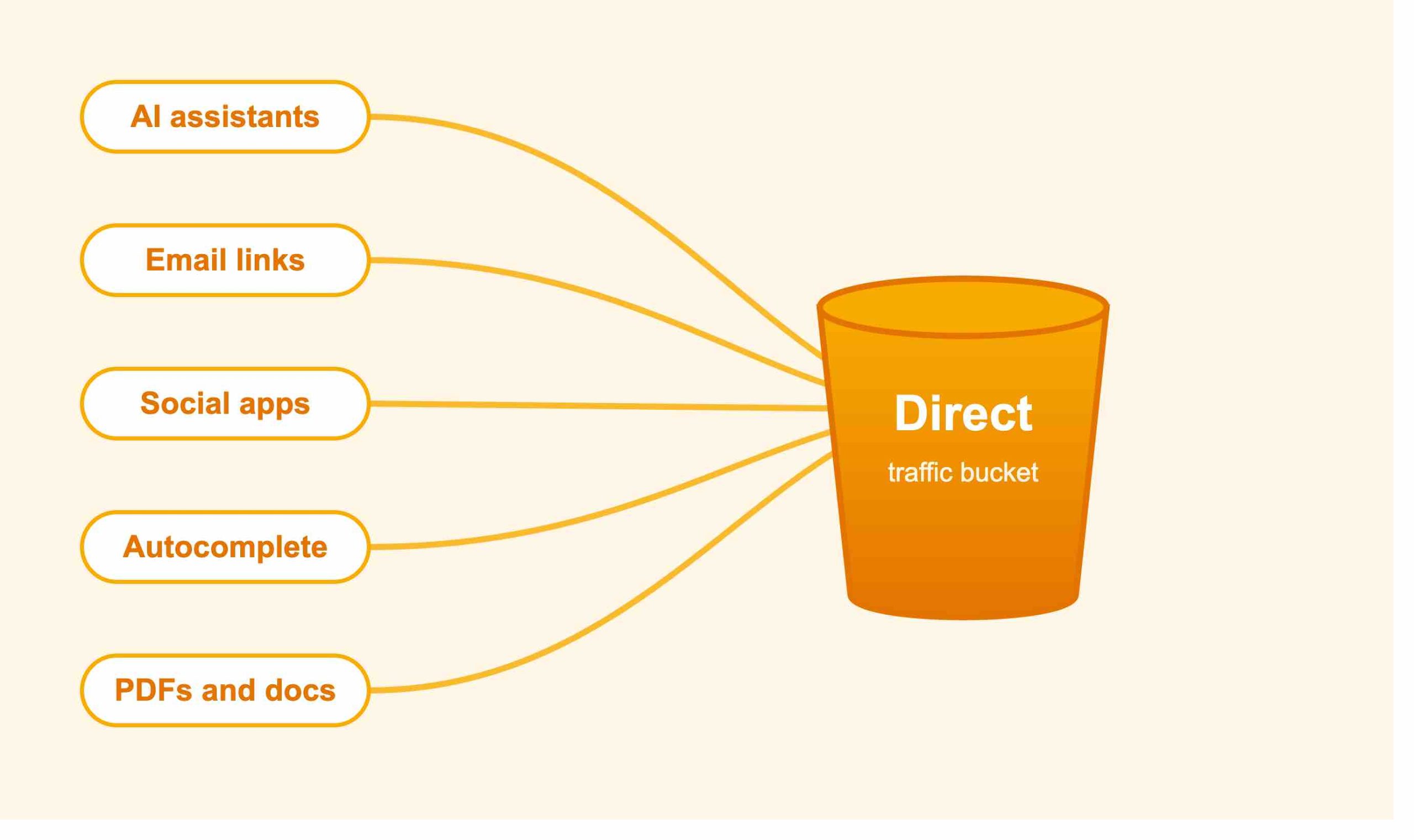
The Top 10 Sources Causing Direct Traffic
Once you break the Direct bucket apart, most of it traces back to a fairly short list of causes. Here are the ten most common, ranked roughly by how often they show up in a typical GA4 account today.
- AI chatbot referral stripping. Clicks from ChatGPT, Perplexity, Gemini, and Claude that lose their referrer through in app browsers, native mobile apps, or copy pasted links.
- Untagged email campaigns. Any email link without UTM parameters, especially from desktop email clients that don't pass referrer data cleanly.
- Browser autocomplete and predicted URLs. Returning visitors who type a few characters and let the browser complete the rest based on history.
- In app browsers on social and messaging platforms. Links opened inside Instagram, LinkedIn, TikTok, Slack, Teams, or other apps with embedded browsers that strip referrer headers.
- Bookmarks and saved links. Genuine repeat visits with no referrer data by design.
- HTTPS to HTTP referrer stripping. Traffic moving from a secure to a non secure site loses referrer info due to browser security policy.
- Zero click search follow up visits. Someone sees your brand in an AI Overview or featured snippet, doesn't click, then returns later via typed URL or bookmark with no link back to the original impression.
- PDFs, Word docs, and other non web documents. Links inside downloadable files carry no referrer when clicked.
- Broken or missing tracking tags. Site migrations, redirects, or botched analytics implementations that silently drop referrer or UTM data.
- Manual URL entry from offline sources. Business cards, print ads, packaging, podcasts, or word of mouth where someone types your URL from memory. Often the smallest slice of the bucket today.
Reviewing this list against your own Direct traffic segment is usually enough to explain most of the number. If you rule out the first nine and still have a large chunk left over, that remainder is likely your genuine, textbook Direct traffic.
Why a Spike in Direct Traffic Isn't Always Something to Celebrate
It's tempting to read a rising Direct traffic number as proof that brand awareness efforts are paying off. Sometimes that's true. But a sudden spike is just as often a symptom of something breaking in your tracking setup. A botched domain migration or redirect that strips referrer data, missing UTM parameters on a new email campaign, an app or messaging platform that changed how it passes links, or analytics tags that failed to fire correctly after a site update can all cause the same kind of jump.
The way to tell the difference is trend shape. A gradual, sustained increase in Direct traffic alongside rising branded search volume usually does reflect growing brand recognition. A sharp, sudden jump, especially one that lines up with a site change, a new campaign launch, or a domain move, is almost always a tracking problem worth investigating before you credit it to marketing success.
How to Shrink Your Direct Bucket and Recover Real Attribution
You can't eliminate Direct traffic entirely, and you shouldn't try to. But you can meaningfully reduce how much of it is actually misattributed traffic hiding in plain sight. Tag every campaign link with UTM parameters, including email, social posts, and any content you distribute off site. Set up custom channel groupings in GA4 to catch known AI referral domains and messaging app sources that would otherwise fall through to Direct. Periodically audit your Direct traffic segment by landing page. A disproportionate share of Direct sessions landing on a page that was just linked in an untagged email campaign is a strong clue. And track branded search volume alongside Direct traffic over time. When both rise together, it's a much stronger signal of real brand growth than Direct traffic alone.
Bringing It All Together
Direct traffic used to be a relatively simple category, people who knew your URL. Today it's a catch all shaped by smarter browser autocomplete, a search landscape where most queries never produce a click, and AI platforms that frequently strip away the very data that would tell you where your traffic really came from. None of this means Direct traffic is meaningless. It just means it needs more context than a single number on a dashboard can provide. The businesses getting the clearest picture are the ones treating Direct as a starting point for investigation, not a final answer.
Understanding Direct Traffic in Analytics, Frequently Asked Questions
What percentage of Direct traffic is considered normal?
Most established sites see Direct traffic in the 10 to 20 percent range. Numbers consistently climbing above 30 percent usually point to tracking gaps rather than a genuine surge in people typing your URL from memory.
Does Direct traffic mean these visitors are more valuable?
Not inherently. Some Direct traffic includes high intent AI referral visits and returning brand loyal users, but the bucket is a mix of many different behaviors, so it's not a reliable proxy for lead quality on its own.
Can I ever fully eliminate Direct traffic?
No. Some amount is unavoidable, since certain sources like typed URLs, offline links, and some document clicks will never carry referrer data no matter how well tagged your campaigns are.
How do I know if my Direct spike is a tracking issue or real brand growth?
Check whether it lines up with a site change, redirect, or new campaign launch. If it's sudden and isolated, suspect tracking. If it's gradual and paired with rising branded search volume, it more likely reflects genuine brand awareness.
Is AI referral traffic a big deal if it's just a small slice of Direct?
It's worth tracking closely even at a small percentage, since AI referral visits tend to convert at meaningfully higher rates than average traffic. A small slice of high converting traffic can matter more to revenue than a much larger slice of low intent visits.