Most small business owners think they cannot afford strategic marketing help. I hear a version of this almost every month from a new client. They tell me the budget is tight, the ad spend is already stretched thin, and hiring outside help feels like a luxury they will get to next year.
Then we open their Google Ads account or their analytics dashboard, and the story changes. The money was never the problem. The absence of a strategy behind the money was.
I have spent over twenty years running marketing for brands of every size, from enterprise companies like Wacom Technology to local businesses across Portland and New Orleans. The pattern is the same everywhere. A business without strategic marketing leadership does not save money. It just spends the same money less carefully, and the cost shows up somewhere you are not looking.
Your ad budget is already paying for guesswork
Every dollar in a paid media account either has a job or it does not. When I audit a new account, I usually find campaigns that were set up correctly a year or two ago and never touched again. Keywords that stopped converting. Audiences that overlap and bid against each other. Budget sitting in a campaign because it worked once, not because anyone checked if it still works now.
None of this shows up as a line item called "wasted spend." It shows up as a cost per lead that creeps upward every quarter while nobody can explain why. Owners assume the market got more competitive. Sometimes it did. More often, the account simply drifted, because nobody was assigned to watch it with a strategic eye instead of just keeping it running.
A fractional CMO's job includes catching this before it becomes a habit. Not by working more hours in the account, but by asking a different question every month. Is this budget still pointed at the thing that matters most right now, or is it pointed at the thing that mattered eighteen months ago?
A generalist hire costs more than the salary line shows
The alternative most businesses consider is hiring a full time marketing person. On paper this looks cheaper than outside help, until you count everything that salary number leaves out.
A single marketing hire, especially at the level most small businesses can afford, is rarely strong in SEO, paid media, analytics, and brand strategy all at once. Nobody is. So you end up with a generalist who is decent at two or three things and guessing at the rest. The guessing is not their fault. It is a structural problem with asking one person to be a full marketing department.
Here is what that structural gap actually costs.
- Slow ramp time eats the first six months. A new hire needs time to learn your business, your customers, and your systems before they produce anything strategic. That is six months of salary with limited return.
- Blind spots become expensive habits. If your hire is strong in social media but weak in analytics, decisions get made on vibes instead of data, and nobody catches it because there is no second set of senior eyes.
- Turnover resets the clock. Marketing hires at this level turn over often. Every time one leaves, you start the ramp time over again with the next person.
A fractional CMO arrangement solves this differently. You get someone who has already made these mistakes at other companies and will not repeat them at yours, working at a fraction of the cost of a full time senior hire, with no ramp time wasted on hiring and training.
Inconsistent messaging quietly taxes every channel you touch
I ask new clients to pull up their website, their Google Business Profile, their last five social posts, and their most recent email campaign side by side. Almost every time, it looks like four different companies wrote it.
This is not a design problem. It is a strategy problem. When nobody owns the whole marketing picture, each channel gets handled by whoever has time that week, and each person makes reasonable decisions in isolation that do not add up to a coherent brand.
Customers notice this even when they cannot name what feels off. Trust builds slowly through repetition and consistency, and it erodes quickly when your message changes depending on where someone finds you. A prospect who sees confident, specific positioning on your website and then finds a vague, generic post on your Google profile starts to wonder which version of your business is real.
Fixing this does not require more content. It requires one person who sees every channel at once and makes sure they are all telling the same story. That is a strategic function, not a production function, and it is exactly what gets lost when marketing is spread across whoever has bandwidth that week.
SEO mistakes compound instead of disappearing
Paid media mistakes are visible fast. You overspend, you see it in the invoice, you course correct. SEO mistakes are quieter and more expensive over time, because search engines reward consistency and history.
A site that publishes inconsistently, targets the wrong keywords, or duplicates content across pages does not just fail to rank. It builds a track record that makes future ranking harder. I have taken over accounts where the technical setup was actively working against the business, duplicate schema markup fighting itself, thin content targeting keywords with no real search volume, months of effort going toward the wrong goal entirely.
None of this is expensive to fix once someone with the right experience is looking at it. It is expensive to have never checked. The businesses that struggle most with SEO are rarely the ones with small budgets. They are the ones where nobody senior enough was paying attention to catch the drift before it became a pattern search engines had already learned.
What a fractional CMO actually replaces
It helps to be specific about what this role covers, because "fractional CMO" gets used loosely.
- The strategic oversight a full time hire at this budget cannot provide. Someone senior enough to have run marketing at larger companies, applied part time to a business that could not otherwise afford that experience.
- The cross channel consistency that gets lost when marketing is split across freelancers. One person accountable for whether the website, ads, SEO, and content all point the same direction.
- The analytics discipline that catches drift early. Regular review of what is actually working, not assumptions carried forward from last year.
This is not about replacing your existing team or vendors. Most of my work happens alongside an in house person or a specialist agency, adding the strategic layer that connects their work into one plan instead of several disconnected efforts.
The math most owners never run
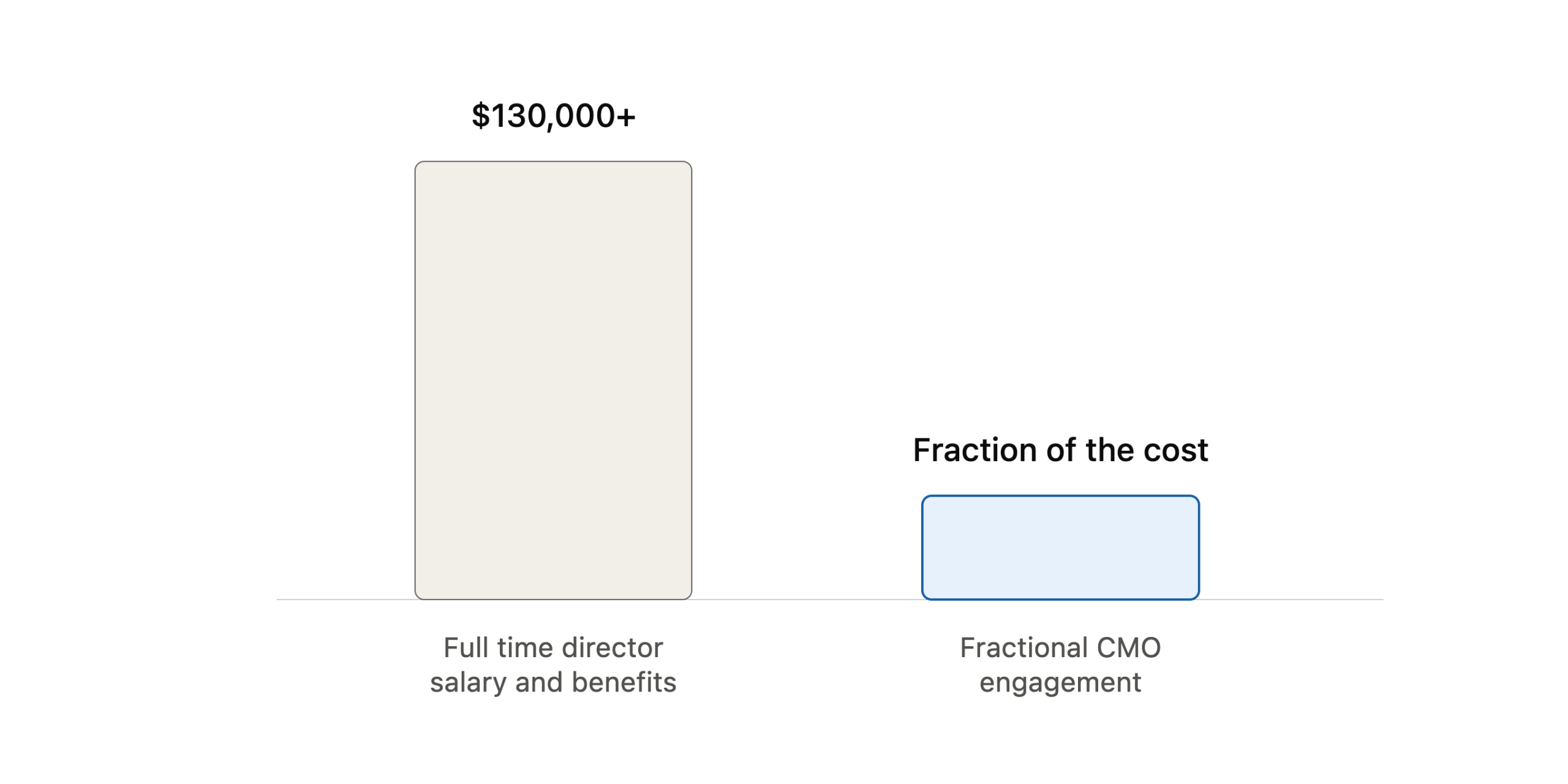
Here is the comparison I walk clients through. A full time marketing director at a competitive salary, with benefits, typically runs well into six figures annually before they have produced a single result. A fractional CMO engagement covers strategic oversight at a fraction of that cost, scaled to what the business actually needs right now.
The real comparison is not fractional CMO against full time hire. It is fractional CMO against the cost of not having anyone thinking strategically at all. That cost is real. It shows up in rising cost per lead, in inconsistent messaging that quietly erodes trust, and in SEO mistakes that take twice as long to unwind once they have had time to compound.
I have worked both sides of this, running marketing inside enterprise brands and now helping small and midsize businesses in Portland, New Orleans, and beyond get that same level of strategic thinking without the enterprise price tag. If your marketing budget feels tight, the honest question is not whether you can afford help. It is whether you can afford to keep running it without anyone watching the whole picture.
If you want a second set of experienced eyes on your marketing before the next quarter's budget goes out the door, that is exactly the conversation I have with new clients first.
What does a fractional CMO actually do day to day?
A fractional CMO oversees marketing strategy across every channel, paid media, SEO, content, and analytics, without sitting in your office full time. The work is usually a mix of monthly strategy sessions, campaign review, and direct guidance to your existing team or vendors so everyone is working from the same plan.
How is this different from hiring a marketing agency?
Most agencies execute a specific service, running your ads or managing your SEO, without owning the strategy that connects those pieces together. A fractional CMO sits above that layer, making sure the agency's work, your in house efforts, and your overall business goals stay aligned.
Is a CMO only for larger businesses?
No. The model exists specifically because most small and midsize businesses cannot justify a full time senior marketing hire but still need that level of experience. It scales down to whatever the business can support.
How much does a fractional CMO cost compared to a full time hire?
What is the first thing you look at with a new client?
Usually the paid media account and the analytics setup. Both tend to reveal quickly whether budget is being spent with intention or drifting on autopilot, and both are fast to audit compared to a full content or brand review.