Most business owners assume an ad works like this. Someone sees it, they click it, they buy. In reality, that almost never happens. A person usually sees your ad, forgets about it, searches for you later, reads a few reviews, compares you to two competitors, maybe visits your site again a week later, and then finally calls. That whole process can take days, weeks, or months depending on what you sell. Understanding where each of those steps happens, and which ad channel is actually doing its job at each step, is the difference between marketing that feels random and marketing that compounds.
Emergency service businesses can get away with skipping most of the funnel
If you run a plumbing, electrical, HVAC, or similar emergency service business, you have something most businesses don't. Your customer already knows they have a problem, and they know it right now. Nobody researches water heaters for three weeks when their basement is flooding. They search, they call the first legitimate looking result, and they book.
That's why these businesses can put almost all their budget into the bottom of the funnel, meaning Google search ads, Local Service Ads, and a strong Google Business Profile, and still do well. The demand already exists. Your job is just to be the answer when someone searches for it. This isn't lazy marketing. It's marketing that matches how the customer actually behaves.
Everyone else has to build demand before the customer knows they need you
Now think about a kitchen remodeler, a med spa, a boutique retail shop, or a professional services firm. Nobody wakes up and searches "kitchen remodel" the same day they decide to remodel their kitchen. They think about it for months. They follow a few accounts, save some photos, ask friends, and slowly build toward a decision. If you only show up when they finally search with high intent, you're competing with everyone else who waited for that same moment, and you've missed months of opportunity to be the business they already trust by the time they're ready.
This is where full funnel strategy matters. You have to be present early, when the person doesn't even know they have a need yet, and stay in front of them consistently enough that when they are ready to decide, you're the name they already recognize.
Not every ad channel does the same job
This is the part most business owners get wrong. They judge every channel by the same metric, usually "did it lead to a sale," and then cut anything that didn't convert immediately. But channels are built to do different jobs at different stages.
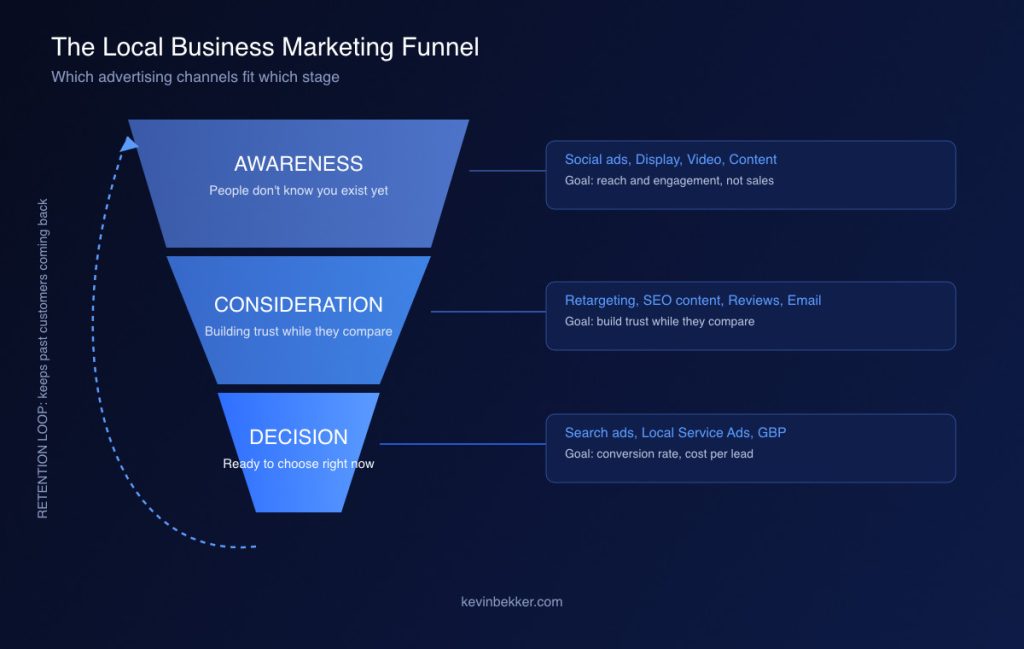
Here's how it generally breaks down for a local business:
Awareness stage. Social ads, display ads, and video are built to introduce you to people who don't know you exist yet. Success here looks like reach and engagement, not immediate conversions.
Consideration stage. Retargeting ads, organic content and SEO, and review platforms keep you in front of people who've already shown some interest. This is where trust gets built.
Decision stage. Google search ads, Local Service Ads, and your Google Business Profile are built for people who are actively ready to choose. This is where conversion rate and cost per lead actually matter.
Retention stage. Email, SMS, and remarketing keep past customers coming back and turn them into referrals.
Below is a simple visual showing how these stages and channels line up.
Optimizing spend means judging each stage by its own goal
Once you separate your channels by stage, you can stop judging awareness ads by conversion rate and start judging them by whether they're reaching the right audience at a reasonable cost. Decision stage channels get judged on conversion rate and cost per lead because that's their actual job. Trying to force every dollar to prove itself with an immediate sale is usually what causes business owners to cut the exact channels that are quietly building the demand their bottom funnel efforts depend on.
What this looks like in Analytics
Inside Google Analytics, this shows up as multi channel paths and assisted conversions. Instead of only crediting the last click before someone converts, you can see the full sequence, social ad, then organic search, then a direct visit, then a conversion. Assisted conversions show you which channels were part of the journey even when they weren't the final step. If you've never looked at this report, it's usually the moment a business owner realizes their "underperforming" channels were actually doing real work upstream.
Tracking techniques that tell you the truth
A few things make this kind of tracking actually reliable. Call tracking numbers let you see which channel led to a phone call, not just a form fill. UTM tagging on every campaign link lets you trace traffic back to its exact source. Your Google Business Profile insights show how people find and interact with your listing. And tying all of this back into your CRM lets you follow a lead all the way from first click to closed sale, which is the only way to really know what's working.
Bringing it together
Full funnel strategy isn't complicated in concept, it's just a lot to manage well at once, matching the right channel to the right stage, tracking it accurately, and adjusting spend based on what each stage actually needs to succeed. This is usually where a fractional CMO earns their keep, not by running more ads, but by making sure every stage of the funnel is working together instead of competing for credit.
If you want a second opinion on whether your current ad spend actually matches how your customers really make decisions, reach out and I'll walk through it with you.